The Games We Play
... and how they shape us become...!!!

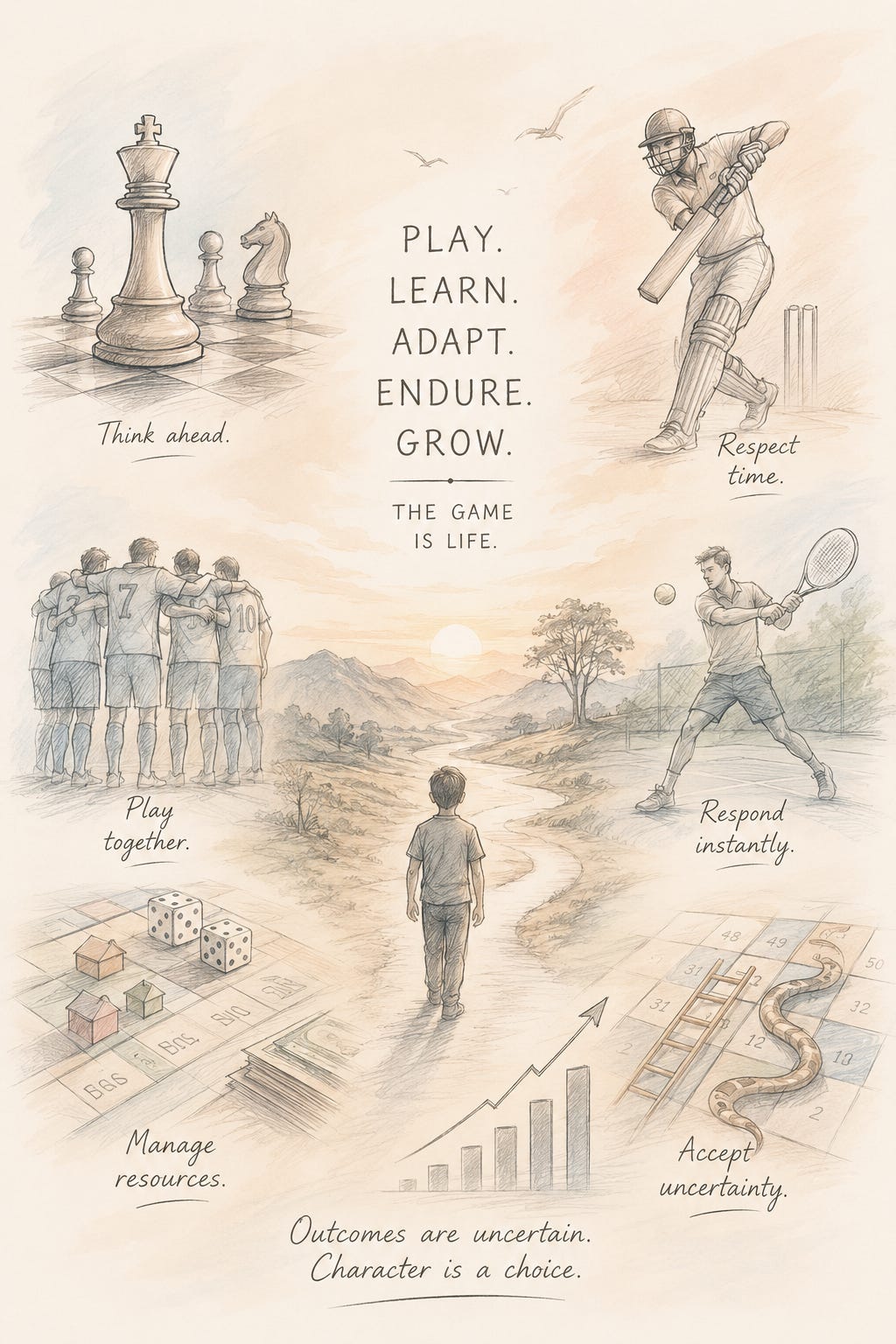
Before Life Begins
Long before strategy became a corporate word,
before psychology became a discipline,
before investing became an industry,
human beings were already learning risk, patience, timing, resilience and consequence through games.
The playground was civilization’s first classroom.
A child playing Association football is not merely chasing a ball.
He is learning movement, space, and trust.
A teenager losing at Chess is not merely losing a match.
He is confronting a consequence.
A batsman defending difficult overs in Cricket is unknowingly rehearsing patience for life itself.
Games are the first place where human beings learn that effort and outcome are related, but never guaranteed.
Perhaps that is why games matter so deeply.
They are not distraction from life.
They are preparation for it.
The Education Inside Game Play
Schools largely train memory.
Games train judgment.
And judgment quietly shapes destiny far more than information ever can.
Games make human beings experience truths before they become capable of explaining them.
A child repeatedly losing learns recovery.
A player dropped from a team learns rejection.
An athlete returning after failure learns resilience.
Without realizing it, games introduce the deepest laws of existence: uncertainty, probability, discipline, timing, and adaptation.
“The art of living is more like wrestling than dancing.”
— Marcus Aurelius
Perhaps that is why excessive protection weakens people.
A generation protected from defeat often becomes emotionally unprepared for meritocracy.
Children cry after losing a game.
Adults spend decades pretending they are not losing at life.
Chess is perhaps the purest metaphor for life and investing ever created.
Not because it teaches victory.
But because it teaches consequences.
Every move alters the future.
Every careless decision weakens the structure somewhere unseen.
The amateur searches for the next move.
The master studies the position.
And every position in chess is governed by three foundational forces;
Time, Space, and Material.
Time teaches rhythm and patience.
Move too early, and the structure collapses.
Move too late and the opportunity disappears.
Space teaches positioning.
The player controlling more space controls more possibilities.
Material teaches resource allocation.
Every piece carries value, but value changes with context.
Remarkably, life and investing obey the same architecture.
Time becomes compounding.
Space becomes optionality.
Material becomes capital.
That is why great investors often resemble great chess players.
They think in consequences, not excitement.
In positioning, not noise.
In endurance, not applause.
And perhaps the deepest lesson of chess is restraint.
Not every opportunity deserves participation.
Not every battle deserves aggression.
Sometimes survival itself is a strategy.
“The winner of the game is the player who makes the next-to-last mistake.”
— Savielly Tartakower
Perhaps that is true of life itself.
Monopoly and the Seduction of Ownership
Monopoly appears to be about money.
It is actually about power.
The game quietly reveals;
ownership compounds,
liquidity creates survival,
Leverage magnifies both genius and stupidity,
Cash flow creates optionality.
But its deeper lesson is structural.
Concentration changes the game…
Once ownership clusters, the nature of the game shifts.
Survival becomes harder.
Options shrink.
Power compounds.
The board is the same.
The game is not.
Exactly like capitalism.
Exactly like markets.
Early positioning matters…
A few well-timed assets change the trajectory.
Momentum, once established, compounds quietly.
Late intelligence rarely defeats early positioning.
Liquidity decides survival…
Many do not lose because they are wrong.
They lose because they run out of cash.
Being right too early is indistinguishable from being wrong.
Leverage exposes, not creates intelligence…
Used well, it accelerates.
Used poorly, it ends the game.
And beneath it all lies the hardest truth.
The game is not won by the smartest player.
It is won by the one who lasts.
Monopoly teaches endurance.
Not brilliance.
Endurance.
Because most players do not fail due to a lack of intelligence,
but due to impatience.
“Power is not revealed by striking hard or often, but by striking true.”
— Honoré de Balzac
Cricket and the Intelligence of Time
Cricket is perhaps the greatest teacher of rhythm.
Like every serious craft, it is built on talent,
refined through discipline,
and tested in time.
There is space for both extremes.
The violence of Yuvraj Singh’s 12-ball assault,
and the quiet endurance of Geoff Allott’s long, scoreless resistance (a 100+ minutes 77-ball duck).
Both belong.
Because cricket is not a game of strokes.
It is a game of judgement.
Every ball asks a question.
Not every ball deserves an answer.
Play fewer shots…
Most damage comes not from what you miss,
but from what you should never have played.
Restraint is not a defence.
It is a selection.
Respect phases…
There are moments to attack,
and long stretches where survival is the only strategy.
Confuse the two, and the innings ends early.
Context decides correctness.
Endure the quiet…
Test cricket rewards those who remain disciplined
when nothing appears to happen.
No applause.
No visible progress.
Minute by minute, over by over, session by session
Just time.
That is where most break.
That is where compounding begins.
Separate quality from outcome…
A perfect ball may still be struck for four.
A poor ball may still take a wicket.
Outcome and quality are related,
but never guaranteed.
Confuse them, and judgement corrodes.
Build partnerships…
No meaningful innings (life) is built alone.
Trust, rhythm, and stability
outlast brilliance.
A lonely genius rarely compounds.
Know when (and what) to leave…
The leave is cricket’s most underrated skill.
Not everything deserves engagement.
The ability to ignore
is as valuable as the ability to act.
And then the hardest truth.
You can play a near-perfect innings,
and still lose the match.
“The key to batting is not how many shots you play, but knowing which ones not to.”
— Sunil Gavaskar
Cricket (and life) does not reward fairness.
It rewards endurance.
A player built for speed may fail in time.
A strategy that thrives in one condition collapses in another.
That is not injustice.
That is structure.
And somewhere between patience and pressure,
between discipline and drift,
one learns;
In modern life... while score counts too...
You are not rewarded for effort.
You are rewarded for staying at the crease
long enough for the game to turn.
That realization alone
can save decades of confusion.
Tennis and the Solitude of Responsibility
Tennis strips away illusion.
No teammates.
No hiding.
No external blame.
Only you.
Play the point…
The past is irrelevant.
The future is imaginary.
Most errors come from carrying both into the present.
Reset. Execute.
“In tennis, you don’t know how good you are until you are tested.”
— Andre Agassi
Control what is yours...
Conditions will not cooperate.
People will not behave.
Effort, attitude, intent; that is your domain.
Everything else is a distraction.
Train until it is automatic (second nature) ….
Under pressure, you do not access talent.
You reveal a habit.
Discipline is not preparation.
It is destiny in disguise.
Treat error as data…
Most points end in mistakes.
The difference is the speed of correction.
Repeat the error, you decline.
Refine the error, you evolve.
Observe before you react...
Force is obvious.
Clarity is decisive.
Those who see patterns win quietly.
Own the outcome…
The decision was yours.
The execution was yours.
The result is yours.
The court exposes emotional leakage instantly.
Life eventually becomes tennis.
The decision was yours.
The consequences are yours.
That accountability matures the mind.
And maturity compounds faster than capital ever can.
Responsibility is not a weight.
It is control.
Over time, the lesson becomes unmistakable.
The game is not testing your shots.
It is testing your state.
Your ability to stay present,
to remain composed,
to continue without drama.
You stop playing to win points.
You start playing to reduce unforced errors,
in the game,
and in yourself.
That is when performance changes.
That is when life does too.
Football, Hockey, and Collective Intelligence
Association football teaches that coordinated intelligence defeats isolated brilliance.
Great teams reduce friction between individuals.
Space matters more than possession.
Movement matters more than appearance.
Trust matters more than ego.
Teams often lose not because they lack talent,
But because the ego destroys synchronization.
The ability to dribble, to strike, to dominate is essential.
But it is incomplete.
The game turns in a quieter moment.
When the individual, at the peak of control,
chooses to release.
To pass when the shot is possible.
To share, when the moment is his to claim.
Not as a sacrifice.
As precision.
Because the highest form of brilliance
is knowing when the moment is no longer yours.
And acting before it is too late.
Not being where the ball is,
but being where it is set to be.
Not holding the moment,
but completing it.
The timing of release decides the outcome.
Great organizations operate similarly.
Culture is invisible on spreadsheets.
Yet it quietly determines destiny.
Misaligned brilliance creates noise.
Aligned participation creates flow.
Field hockey teaches something equally profound: transition.
Attack becomes defence instantly.
Momentum reverses violently.
Complacency gets punished without warning.
There is no stable state.
You are either adjusting,
Or you are exposed.
Markets behave similarly.
Narratives change more slowly than reality.
That gap destroys people.
“The ball is always faster than the player.”
— Johan Cruyff
Those who cling to possession of the moment
miss its evolution.
And somewhere between control and release,
between brilliance and timing,
one learns;
intelligence is not in having the moment.
It is in completing it.
Snakes, Ladders, and the Nature of Uncertainty
Snakes and Ladders may appear simplistic.
It is not.
You rise suddenly.
You collapse unexpectedly.
You restart repeatedly.
Children laugh and continue.
Adults resist and resent.
The dice does not remember you.
It carries no memory of effort,
no respect for proximity to the finish.
And sometimes (in fact, many a times), near 98,
it offers the only number you did not want.
You roll it.
You fall.
You begin again.
Not because you were careless.
But because randomness has no obligation to be kind.
The board is not symmetrical.
Uneven odds…
There are more snakes than ladders.
And the ladders are shorter.
Progress is earned slowly.
Loss arrives instantly.
That is not a flaw in the game.
That is a reflection of life.
Progress is not linear…
A ladder does not validate you.
A snake does not define you.
Both are events, not identity.
Position is temporary…
Nearness to the finish is not safety.
The fall from 98 teaches what early victories hide.
Nothing is secured until it is complete.
Randomness coexists with effort…
You play with intent.
The dice moves with indifference.
Serendipity lifts.
Chance collapses.
Both arrive unannounced.
Continuation is the only edge…
There is no strategy to eliminate uncertainty.
There is only a willingness
to remain available to the next roll.
The game quietly whispers an ancient truth;
Life is neither fair nor unfair.
It is dynamic.
“We are prone to overestimate how much we understand about the world, and to underestimate the role of chance in events.”
— Daniel Kahneman
And perhaps maturity is nothing more than learning
to continue rolling the dice,
even after being sent back to the beginning,
without becoming bitter.
Failure as Preparation
Modern society increasingly treats failure as damage.
Games treat failure as training.
That difference is profound.
A child who has never lost becomes fragile before reality.
A child who has lost repeatedly develops elasticity.
Loss stops becoming humiliation.
It becomes information.
And information, if received without resistance,
quietly reshapes the individual.
Not immediately.
Not dramatically.
But slowly, in ways that are not visible to others.
The missed goal sharpens anticipation.
The lost Chess match deepens foresight.
The bad investment refines judgement.
What appears as a setback outside,
becomes calibration within.
There is another layer, less spoken.
Failure introduces proportion.
It reduces the illusion of control.
It softens certainty.
It makes one less absolute in opinion,
and more attentive to reality.
Not weaker.
More precise.
It also alters the relationship with time.
Success compresses time.
Failure expands it.
In that expansion, one begins to observe patterns
That urgency never allows.
And over time, the need to immediately recover
is replaced by the ability to understand.
There is a quiet dignity in that shift.
To not rush away from failure.
To not dramatize it.
To not attach identity to it.
To simply sit with it long enough
for it to reveal its instruction.
Pain, then, stops being an interruption.
It becomes participation.
Not something that happens to you,
But something that works on you.
“There is no coming to consciousness without pain.”
— Carl Jung
Games introduce this truth gently,
before life introduces it brutally.
And perhaps that is their real gift;
They allow one to meet failure early,
in smaller doses,
so that when life raises the stakes,
The individual does not collapse,
but adjusts.
The Shadow Inside Games
Games do not only reveal discipline and resilience.
They also reveal envy, insecurity, and ego.
A child unwilling to pass the ball often grows into an adult unable to share credit.
A player obsessed with scoreboards may eventually mistake achievement for identity.
Games expose emotional truth with frightening honesty.
Some collapse under pressure.
Some become arrogant after victory.
Some cannot tolerate defeat without resentment.
There are subtler shadows.
Comparison enters quietly.
Joy begins to depend on someone else’s failure.
Validation becomes external.
Effort becomes performative.
One starts playing not to improve,
but to be seen improving.
Control becomes illusion.
The desire to dominate replaces the discipline to understand.
The need to win replaces the willingness to learn.
And slowly, the game is no longer played.
It is consumed.
There is also an attachment.
To form.
To past success.
An identity built around winning.
And when the game changes,
The player resists.
Not because the game is unfair,
but because the self is inflexible.
And perhaps the most dangerous shift;
the inability to separate outcome from self.
A loss becomes a judgement.
A win becomes a validation.
Both distort.
Because neither were ever meant to define.
Yet this is precisely why games matter.
They surface these distortions early,
in smaller arenas,
with lower stakes.
They reveal human nature before life amplifies it.
Winning tests character as much as losing.
Sometimes more.
Because defeat humbles quickly.
Victory deceives slowly.
Games do not only reveal discipline and resilience.
They also reveal envy, insecurity, and ego.
A child unwilling to pass the ball often grows into an adult unable to share credit.
A player obsessed with scoreboards may eventually mistake achievement for identity.
Games expose emotional truth with frightening honesty.
Some collapse under pressure.
Some become arrogant after victory.
Some cannot tolerate defeat without resentment.
And perhaps that is precisely why games matter.
Because they reveal human nature early,
before life raises the stakes.
“Man is not what he thinks he is, he is what he hides.”
— André Malraux
Winning tests character as much as losing.
Sometimes more.
The Four Games Every Child Should Play
A growing individual should ideally experience;
One board game for strategy,
One team sport for cooperation,
One individual sport for accountability,
One racket sport for coordination and reflex.
The board game sharpens foresight.
The team sport dissolves ego.
The individual sport reveals character.
The racket sport builds rhythm between mind, eye, and body.
Games like Tennis, badminton or table tennis cultivate mechanical coordination of remarkable depth.
They sharpen reflexes, anticipation, balance, and timing.
The body learns to respond before the mind fully processes.
And over time, instinct itself becomes intelligent.
There is another layer.
The board game teaches consequences without movement.
The field game teaches awareness without possession.
The individual sport teaches accountability without escape.
The racket sport teaches precision without delay.
Together, they train different dimensions of attention.
They also shape the relationship with time.
Strategy slows it.
Team play distributes it.
Individual play intensifies it.
Racket play compresses it.
One learns when to wait,
when to act,
when to trust,
when to respond.
And beneath all of this, something quieter forms.
The ability to stay present without agitation.
To engage without overreaction.
To adjust without resistance.
Not as philosophy.
As a habit.
“Tell me, and I forget; teach me, and I may remember; involve me, and I learn.”
— Benjamin Franklin
Together, these four forms of play shape balanced human beings.
Strategic in thought.
Collaborative in action.
Responsible in judgement.
Coordinated in execution.
Games and the Investor’s Mind
Investing is often mistaken for intelligence.
In reality, it is far more a test of temperament.
Markets resemble sport far more than mathematics.
The same disciplined shot in Cricket may produce different outcomes under different conditions.
The same investment process may produce wildly different short-term outcomes under different cycles.
That is what games prepare the mind for.
A batsman cannot control every ball.
An investor cannot control every cycle.
A player in Chess cannot control the opponent’s move.
But both can control preparation, positioning, and response.
Games quietly teach the sacredness of process.
You may lose despite doing the right thing.
You may occasionally win despite doing the foolish thing.
A perfectly constructed position in chess may still collapse.
A near-flawless innings in cricket may still end in defeat.
But over time, methods reveal character.
And character eventually reveals outcomes.
Markets do not introduce new emotions.
They amplify existing ones.
The investor who cannot wait
was once the player who could not defend.
The investor who overacts
was once the player who chased every ball.
The investor who panics
was once the player who could not absorb a loss.
Markets do not merely test intelligence.
They test emotional continuity under uncertainty.
Most investors intellectually understand compounding.
Very few psychologically survive long enough to experience it.
Much like in Snakes and Ladders,
where progress can reverse near completion,
markets punish those who mistake position for permanence.
Investing punishes the inability to sit still
almost as brutally as it punishes ignorance.
The hardest move, in markets as in Tennis,
is often not execution,
but restraint.
“The bowler has the ball. Fate has the pitch.”
— Neville Cardus
And perhaps that is the quiet bridge between games and markets;
The outcome is uncertain,
But the behaviour is not.
And behaviour, repeated long enough,
becomes destiny.
The Game of Life
Games were never merely a recreation.
They were rehearsals for uncertainty,
training grounds for judgment,
simulations of adversity,and
preparation for existence itself.
Perhaps that is why playing matters far more than watching.
Watching creates spectators.
Playing creates nervous systems capable of handling pressure.
Games teach participation despite unpredictability.
You play despite risk.
You return despite defeat.
You continue despite uncertainty.
A rally in Tennis does not guarantee the point.
A position in Chess does not guarantee victory.
A climb in Snakes and Ladders does not guarantee arrival.
And somewhere between scoreboards and silence,
between ambition and surrender,
between victory and defeat,
Games quietly shape the human being beneath the personality.
For eventually one realizes;
Life begins to resemble a game without edges,
a field without markings,
a contest without a final whistle.
Like an endless test match in Cricket,
where time itself becomes the opponent,
And endurance becomes the only strategy.
There is no clear start.
No defined finish.
No agreed score.
And yet, the patterns remain.
You position.
You wait.
You act.
You lose.
You recover.
You continue.
Some play aggressively and burn out.
Some play cautiously and never arrive.
Some mistake movement for progress.
Some mistake stillness for wisdom.
And a few begin to understand;
Perhaps the true purpose of games was never victory at all.
It was to teach human beings
how to remain graceful amid uncertainty.
How to lose without collapse.
How to win without arrogance.
How to endure without bitterness.
In other words;
How to play the game of life…?
The Disclaimer
This article reflects my personal thoughts and interpretations from my professional experience. It does not represent the views of my current/prior employer(s) or any associated entities. AI tools have been used liberally to support drafting and articulation, while the ideas and conclusions remain individual. Any resemblance to other analyses, opinions, or writings is purely coincidental/inspired.